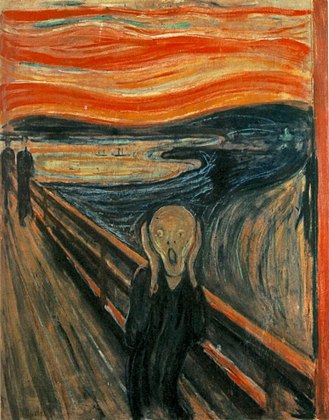
Tuesday, March 28, 2017

What's on my mind?

Well I think the best description of what's on my mind is to ask what isn't on my mind? The answer of course is tax season because nobody likes tax season except maybe the government. Why is the man in The Scream screaming?

wikipedia.com
Probably because he forgot to do his taxes.

But all jokes aside, well for now at least. I would say what is on my mind most is just keeping up with my exams and homework. I am ready for a change of pace though. I am ready to leave for Spain. 

I would say the most exciting thing about traveling abroad, from the perspective of someone who has only been to Mexico and Canada 🍁, is getting to enjoy the entire new scenery. I will have so many pictures to take and get to see an entire new set of buildings, streets, and cars. And, best of all I DON'T have to see the same city with the same set of roads and irritating traffic lights I always get stuck at for way too long. Like okay come on, every town has those lights where there are no cars going the other way, but then they stop you for what feels like hours, especially when you have somewhere you need to be. So, anyway, I will be enjoying a different place with different scenery and different things to keep me busy. 

I am most excited about practicing my Spanish skills. I really hope that I can find a native speaker that likes running. Then, we can run together and I can practice Spanish with him or her while we run. That way, I would get to practice Spanish, and I would get to explore the city and surrounding area through running. If you have never been running in a place you have never been before, I suppose I ought to explain a little. 

Firstly, running and hiking can be similar in this way. There are a variety of secret secluded often natural wonders that you cannot reach any other way but on foot. Running is just a bit faster than hiking, so you get all of the freedom which comes with hiking but faster so as to see more. The one downside of running is that you usually don't have your phone with you, so you don't necessarily get all the pictures of hiking; however, I would argue this is best. Some things are more powerful to experience with their associated temporary nature. A picture preserves something that is constantly changing, but if you are in that moment you get to see everything just as it is and will never be again. There is also a great power in holding a secret place with no evidence. To be able to share the beauty, you have to take the person you want to share with to that place to see for themselves. 
That said, I am a huge fan of catching the absolute perfect moments:


I mean how often do you catch a sunset with the perfect amount of clouds that happens to align perfectly with the flag on the top of the union? So, I would say I love to find those perfect things that are just so perfect and powerful that they compel you to seek out that personal place and those special moments for yourself such as I don't know maybe the secret of the bell tower:


That's forged into one of the enormous bells by the way. And no, it's not an image from the internet. Instead I suggest you discover the secret yourself because I would never want to deprive you of that moment. So maybe don't be afraid to do a little poking around where you think you probably shouldn't be because you might just find out you're in luck and exactly where you are supposed to be. Although here's a hint to a schedule: Click then look for some times

So, I suppose in the end the answer to the question of "What's on my mind?" is really a question of what moment is it right now and what could I possibly be thinking about because as you may have noticed from what is above, just about everything is on my mind depending on what moment you catch me in. 

Saturday, May 9, 2015

A Measure of Restraint

According to Chet Raymo science is a deadly foe that must be kept restrained to prevent danger. Therefore, humans as a species must exercise restraint in the pursuit of supposed advancement. His first example is Cesium-137, "a highly radioactive substance...with the power to damage living cells" (Raymo). Immediately it appears that science is the enemy. Raymo is severely one-sided in his discussion of the Cesium, only bluntly presenting the death of a girl and the contamination of many others. He fails to mention the indefinite number of people that may have been helped by the clinic. Also, the wide misuse of radium in paint and as a source of seemingly magical light is exactly that. It is not the scientists' fault that radium was misused. There is, once again, no mention of the use of radium as a cancer treatment to provide both sides of the argument after Raymo describes the "'radium roulette,' with a glowing wheel and ball." Finally, his  trepidation about genetic alterations in such things as food may have appeared very valid. He was right; well, in a way. After the writing of "A Measure of Restraint" genetically modified food began and has since taken over the world. Then again, it took over the world by providing more than 4 billion acres of crops to feed a growing population rather than in some apocalyptic reign of the plants (ISAAA). Raymo is right that restraint must be exercised, but his approach of only attacking science comes across as a scare tactic. It is possible that Raymo should have exercised a measure of restraint in his explanation of the dangers of exploration.

Sunday, April 19, 2015

A Family Matter

This page depicts the reunification of Valdek with his parents after he escaped from being a POW. The meeting is the only time we really see an interaction between Valdek and his parents. Initially the view is through a window as though we are outside observers to a scene of the what a normal homecoming of Valdek might look like. However, immediately after we are inside with them and it is clear that the homecoming is not typical and neither is the family vibe that is going on. Valdek notices that his mother is sick, but that does not really delay him as much as we would hope. His mother ends their reunion quickly to get him back to Anja. It is clear that their family has a unique set of values with the son abandoning a sick mother to go see his wife instead of attempting to care for her in some way. Then, upon further analysis it is apparent that their family is not the what should be scrutinized. The true issue is the Nazi power. Had the "curfew" not been 7:00 Valdek could have listened to his father's troubles and investigated his mother's health. Instead, they are forced to make sure he gets to Anja: "I must bring Valdek home to Anja before curfew." Specifically using "must" emphasizes how the curfew has been imposed on them despite the fact that it is negatively affecting them. The disruption of normal family life is a small example how the Germans managed to dehumanize the Jews. Valdek and his parents are denied and capability of maintaining a family bond.

Displaying IMG_0510.JPG


Saturday, March 28, 2015

Hatin' on Sontag

I decided to do a breakdown of the last persuasive essay in our packet on Susan Sontag's "On Photography" since we did not go over it in class (also I rated the 4 and 7 synthesis essays as 8 and 9 so clearly I need some work on that). The writer of this essay will be referred to as a man named Sue. Firstly, Sue begins his essay with a direct answer to the prompt instead of a hook. It looks more like a thesis, but the real thesis ends the intro. Following the intro, he quotes Sontag and consequently labels her as "dense" (Sue). This statement is supported very well by an analogy of photography to literature (photography : interpretation :: literature : comprehension) that asserts Sontag is missing the interpretation part. Sue's examples of the pictures of the church firebombing, children's suffering, and WWII's end all could serve to refute Sontag's assertion that photographic knowledge will "never be ethical or political knowledge" (Sontag). The only issue is that Sue never directly states his refutation of that lapse in Sontag's assertion; rather he focuses on the feelings side of it that Sontag actually did address. And, although Sue has a great point of photos revealing a finite boundary of the past and present, he only mentions it and follows up with a cliche (not used ironically). So overall I will give it, with much trepidation, a 7.

In any comments, please hazard a guess at the score yourself.

Sunday, March 22, 2015

The Value of a Life

John Mueller, Ohio State political scientist, says, "the value of a statistical life turns out to be around $5 million" and when a soldier is killed "the government pays the family $600,000." When considering a human life including all of the potential ideas and capabilities of that person, regardless the true identity of the person, a dollar amount could never be set. How could all of the potential accomplishments be valued when one cannot see the future? Then we involve business and monetary decisions associated with roads and driving. Yes, modern and well maintained streetlights on every single road where a car may drive could prevent accidents and by association death. The other yes that comes with new, ample lighting is that it would be costly. But why don't we call the state official that voted against new streetlights in every neighborhood in Kansas a mass murderer because he believed the budget could not afford for that. Why not just arrest every official debating safety? There is no way to pay for every safety measure when lives priced at $inv,alu,eab.le even if that is what seems right. Should we state the new proposal "50 lives for $500 million?" What would you value your life at? How about a love one's? Then ask yourself who could pay for that and would they? Maybe not.

Sunday, March 15, 2015

Richard

During her great party in the book, Clarissa describes happiness when she is near Richard and shows evidence of the bond between them. She mentions Sir William Bradshaw and the sense of dislike she has for him. The only confirmation she has for these negative feelings is that "Richard agreed with her, 'didn't like his taste, didn't like his smell'" (Woolf 183). Through her use of Richard's opinion to back up her own, Clarissa exemplifies how she trusts him and values his thoughts; she and Richard rely on each other. Also, Clarissa notes how she "had never been so happy," and that was "due to Richard" (Woolf 185). It is clear they share a tight bond and although it may not be sexual it is very important to Clarissa. However, this whole relationship is, apparently, much less important in the movie version of Richard and Clarissa. Although Richard is basically incapacitated and Clarissa is fully aware of his plan to open the window and jump out, she refuses to walk the ten feet to prevent his suicide. Rather, she stands there babbling and acting like he is already dead because she is just going to let him jump anyway. Now she can just enjoy her relationship with Sally, only inconvenienced by the fact that she cannot have the party she wanted to have for herself under the cover of a celebration for Richard.

Sunday, March 8, 2015

The Hated Hugh

Hugh is constantly referred to as admirable. However, only the women hold Hugh highly (except Sally). Peter, who possesses no negative view of anyone else, notes that those who are "battering the brains of a girl out in a train do less harm on the whole than Hugh Whitbread and his kindness"(Woolf 173).  This bold statement is brutal but does not seem to hold much weight because the concept of kindness causing harm is paradoxical. The men see him as completely priggish, yet a negative effect of Hugh's acts cannot be found. Although I struggle to find the true issue, I suspect that they hold a strong dislike for Hugh because he perpetuates the stereotype of the British upperclassman. (Sally, being a radical, partially resented the rich English society and, therefore Hugh.) His continuance of a rich stereotype explains the reactions of the women including Lady Bruton and Clarissa. All of them enjoy the feeling of high society. Hugh's mannerisms represent that society so their association with him makes them feel accepted in the upper class. For example, the older women at the party end up "thinking themselves quite forgotten," but then they find "dear Hugh driving up and spending an hour talking" (Woolf 173). The metaphor of the women being brought back into the atmosphere of the party by talking to Hugh represents how he makes the women to feel connected with the upper class because he embodies the privileged man with perfect manners and an air of wealth.

Sunday, March 1, 2015

Rezia

Regent Park

Lucrezia's lament for her life, page sixty five, pulls details from her surroundings that remind her of everything troubling. When a child "[runs] full tilt into her...and burst[s] out crying," she finds it comforting (Woolf 65). This comfort is short-lived, however, because Septimus will not have a child with her. The motherly nature can only be exercised on children that happen to cross her path and will leave just as quickly as the "child ran straight back to its nurse" (Woolf 65). A positivity associated with caring for the little girl immediately deteriorates into remembrance of Septimus and his refusal: negativity. As though the lack of a child to love is not enough of a burden, the everyday scene of "the broad path, the nurse, the man in grey, the perambulator" forces her to realize her vulnerability (Woolf 65). She is in a foreign country with a husband unable to comfort her despite the fact that it is his domain, not hers. The stress of her life results in a pessimistic mindset at the park, and superficial setting details and common occurrences are transformed into reminders of Rezia's suffering. It reminds me of just having a bad day when the weight of life seems to hang over you like a stalking cloud; nothing relieves without an embrace of optimism. The nature of Rezia's frequent laments leads me to believe she may be the embodiment of Woolf's spells of severe depression. There is no way a person could feel like that in Regent's Park.

Tuesday, February 17, 2015

Can't Disobey a Rule that Doesn't Exist


Although the essay on Gary Soto's piece might not be included in this week's discussions, the rewrite was this week. I came across an underlying irony in revising my essay: Soto must retain the moral that stealing is wrong in order to experience the guilt he craves. After stealing, he still asks the rhetorical question regarding the howling in his plumbing, "Was it God?" (Soto 80). Despite defying God, he still feels like it could be Him that is speaking to him through the pipes under his house in the "cool shadows" (Soto 79). This provides a contrast of the darkness under the house versus the light associated with the potential divinity that exists there. Even in the darkness of Soto's refuge from blame, a shred of holiness exists fighting to get through to him. Also, Soto retains the religious feelings like the gaze of God that makes up the "glare of the pie tin" (Soto 86). The glare is what convinces him to take refuge then greets him as he emerges. This before and after appearance of God's gaze serves to exemplify how Soto will keep some religious influences before his sin and after regardless of what occurs in between because of the nature of his guilty pleasure. He must embrace part of the rules of Christianity in order to gain pleasure through breaking them. Otherwise, he would have no guilt and no exhilaration.

Sunday, February 8, 2015

Ethinc Food Fetishes

The cultural applications of "Fish Cheeks" by Amy Tan are very prevalent; however, I found the basic topic of ethnic foods intriguing. Tan describes her ethnic food in the way the typical white American, played by Robert, would: "appalling mounds of raw food"(Tan). She had squid that "resembled bicycle tires," tofu that "looked like stacked wedges of rubbery white sponges," and "slimy rock cod" (Tan). Her negative diction describing her own ethnic food derives from the fact that she is only thinking of how Robert will see their food and culture. In truth, those were all of her favorite foods. This contrast in how cultures view their own ethnic food compared to how they view other cultures' got me thinking. According to the European Food Information Council (EUFIC), food preferences are based on more than taste and appearance. In fact, the most important thing is how we experience the food. When food is associated with a positive experience like sugary cake and ice cream on a birthday, it is more likely a person will enjoy that type of food and similar flavors. The opposite is true for food associated with negative experiences like an argument over dinner. In addition to associations with experiences, food preferences and aversions are influenced by exposure to food, even prenatally. Through repeated exposure to specific foods, taste preferences to them are often developed. Also, there exists an innate neophobia, fear of new food (EUFIC). Although neophobia is often easy to overcome for older children and adults, these concepts may explain another influence on Amy and Robert's Christmas Eve dinner.

Saturday, January 31, 2015

Mairs's Maze


In her essay "Disability," Nancy Mairs constructs a maze from preconceived notions all the way to her thesis. Each concept she presents acts as a fork which must be interpreted the right way otherwise it will lead to a dead end that forces some backtracking to get back to the true point of her essay. Mairs opens with a description of herself as "crippled with multiple sclerosis" and "easy to spot in even in a crowd" because of her "peculiar gait." This description can be said to appeal for sympathy. However, Mairs is really trying to establish her ethos to discuss disability in general. This is apparent in her use of the blunt word "peculiar" with its negative connotations to describe herself. Also, Mairs’s criticism of the medical drama must be seen to derive from the character of “Ms. MS” rather than her actions. The real issue she has is that there is no depiction of the able side of the woman with MS even though it is there. Mairs reveals it is there with her catalogue of her activities as “Ms. Great American Consumer” because she “drive[s] a car,” “eat[s] pizza,” and “menstruate[s]” which hints at the true criticism through an association of basic, ordinary activities and disability. By following the correct interpretations, Mairs’s thesis can be realized. The media’s lack of reality regarding disability imperils the temporarily able bodied as well as alienates the disabled.


Sunday, December 21, 2014

Tribute to F. Scott Fitzgerald

Please note as you read that this is intended to be entirely satirical and ironic in order to reveal the flaws of Lindner's thinking.

I do not understand. Neither can I comprehend the thoughts of these people. There is a reason they cannot come into our neighborhood. Democracy has truly failed in the allowance of color in a white neighborhood. Clybourne Park will be tarnished and our families defiled. I humble myself to enter under their roof offering them "financial gain," and they, blinded by their pride, do not see the generosity of my offer (Hansberry 118). Their appalling lack of sense is not something I can permit to be contracted by my children. "[R]ace prejudice simply doesn't enter into it" (Hansberry 118). My sole intention is to promote happiness. "[O]ur Negro families are happier when they live in their own communities," and I cannot be responsible for any unhappiness or dangers of their decision (Hansberry 118). I am not sure they comprehend the generosity of our offer and the wealth it can bring them both economically. They could escape their small ghetto to a larger and nicer house if they only had the common sense and aspirations. I was respectful and courteous in both my demeanor and offer. I simply cannot understand the shortsightedness. The repercussions of their decision cannot be linked to me in any way.

Sunday, December 14, 2014

The Longest Blog

In his satirical short story, "Diamond as Big as the Ritz," Fitzgerald demonstrates how materialism corrupts through his use of rhetoric including tone, diction, and irony. Once upon a time, there was a great secluded wonderland amidst Montana's share of the Rockies where all were waited on hand and foot. If desired Braddock Washington, any of his family, or even John Unger, his guest, could summon Moses to retrieve an army of pink elephants within the hour. This is the world that Fitzgerald creates in his short story: "a sort of floating fairy-land" (Fitzgerald 82). The great fairy-land is really a satire to depict the flaws of materialism. The satirical tone that pervades the piece is perpetuated with the lavish details that Fitzgerald never ceases to divulge. For example, Fitzgerald describes "an exquisite château [rising] from the borders of the lake" (82), "a large cavity" (93) in which the Washingtons keep prisoner everyone threatening the secret existence of their estate, and an "entire force of negroes" (98). These details all defy logic and are quite frankly ridiculous. The pretentious diction adds to the satire. It is as though an egotistical billionaire is bragging to millionaires. Fitzgerald uses the word "château" instead of mansion or house; he uses the description "a wreath of mignonettes" (90) instead of a ring of flowers in order to enforce the pretentious atmosphere that the Washingtons live in and abide by. In that way, Fitzgerald shows the corruption of character through materialism. On top of that, the irony is overpowering. The ownership of slaves by someone so rich they could pay for servants without care is absurd; the diamond that the Washingtons own is so large that were they to spend it, it would be worth practically nothing compared to a small fraction of it. Also, the diamond is "wired" (111), so when the airplanes break through the defenses, the remaining Washingtons commit suicide inside of it. The materialistic corruption is exemplified through the needless frugality in keeping slaves, the illusion of a fantastic diamond despite its worthlessness, and suicide over a worthless diamond. Theses examples are of pure insanity and corruption. Fitzgerald shows that materialism corrupts yesterday, today, and tomorrow.

Sunday, November 30, 2014

The Void

A dream is an idea that motivates a person into action in an attempt to achieve it. In The Great Gatsby by F. Scott Fitzgerald, Jay Gatsby gets wrapped up in his dream of running away with Daisy, the wife of Tom Buchanan, because she "never loved him" (Fitzgerald 139). As it is exemplified in the novel, the often unattainable visions are essential in life because they provide a motivation to live actively; however, a dream cannot be allowed to obscure reality. Gatsby exemplifies how dreams preserve active life literally when he mentions how he "tried very hard to die" during the war but seemed to have an "enchanted life" (Fitzgerald 70). Despite the fact that Gatsby wants to die in the war, he can't allow himself to because his heart and mind yearn for Daisy and the fulfillment of his vision for them as a couple. The problems arise when Gatsby does not accept anything less than his envisioned play out of events. She admits,"Even alone I can't say I never loved Tom" because it wouldn't be true (Fitzgerald 140). Because Gatsby is unable to let go of the simple desire and accept her love in the present, Daisy becomes involved in the argument with Tom, and she becomes overly stressed. The end result of her stress, though indirect, is the death of Gatsby. His dream provides an active life until he allows it to distort the truths of Daisy's life. Then, it brings death. 

Sunday, November 23, 2014

Thanksgiving Versus Extravagance

The lavish feast of "buffet tables, garnished with glistening hors d'œvre, spiced baked hams crowded against salads of harlequin designs and pastry pigs and turkeys bewitched to a dark gold" (Fitzgerald 44) for Gatsby's party scene in The Great Gatsby is incredible. Just for sake of clarity "harlequin" means in varied colors and "hors d'œvre" are appetizers meant to be eaten by hand. All of the food and drinks combined with extravagant atmosphere create an atmosphere where judgements do not matter. Jordan says the parties are "so intimate" because at "small parties there isn't any privacy" (Fitzgerald 54). The use of the word intimate is ironic because the denotation includes a private atmosphere which is created by the relative anonymity and nonjudgmental attitude encompassed by the party atmosphere. Yet, the connotation of intimate signifies a quiet and small gathering. The use of the description of the food at the beginning of the description is also ironic comparison because the turkey and ham are symbolic of Thanksgiving and Christmas, both of which are prime times for family gatherings and being together, yet the parties have a completely opposite effect creating anonymity and a privacy in being public. Gatsby wants Daisy to come to one of his parties to become close with her once again, but his attempt to find her is misguided. He cannot use a great meaningless party with only guests that alcohol has created to find the woman he has been searching for.

Sunday, November 16, 2014

People and Punctuation

Although young people have been consistently neglecting to use punctuation especially when texting or online, the rules of formal punctuation must remain intact. Some believe that punctuation should be and is evolving as people and technology evolve. The rules remain the same; people have just decided not to use them. Elizabeth Austen challenges the necessity of rules for punctuation in 'On Punctuation" saying she would prefer to pick and choose which one she to adhere to: "not for me the dogma of the period" (1). Changing the rules of punctuation would result in chaos. Poetry is considered an example of how chaos is not the result of rule-free punctuation; however, poetry is often puzzling and ambiguous. Poetry is not used for all forms of writing and could never be used for every written work. Lewis Thomas, a scientist, in his commentary on punctuation, "Notes on Punctuation," writes what could be a grammar textbook demoing a punctuation mark in each paragraph. In a society in which time is increasingly valuable, people cannot waste time deciphering true meaning or dealing with a misunderstanding. Also, a misunderstanding could be dangerous or harmful like in medical and legal practice. It only takes one person that did not get the MEMO about a rule change to create a problem. Punctuation controls the flow of words like a traffic light controls cars, and if one person forgot that the green light now means stop, everyone loses. Punctuation is not evolving with our changing society, and if it ever does, numerous drawbacks will be realized.

Sunday, November 9, 2014

StylisticSkillWithSpacing

Toni Morrison is an extremely stylistic writer. She uses punctuation, sentence structure, and even spacing to enhance her writing in The Bluest Eye. For example, in her introduction Morrison alludes to the children's book "Dick and Jane." She begins with the characteristic very simple sentence structure and punctuation; then, she repeats the same passage without any punctuation just spaces. Finally, she repeats the passage a third time the same as the previous one just without any spaces: "seefatherheisbigandstrongfatherwillyouplaywithjane"(Morrison). The simplicity of the content allows the structure to shine through as a pertinent aspect. With each repetition of the initial passage, the tone gets more frantic and hurried. Also, the lack of space adds a trapped feeling because there is no space. The experience of the introduction acts as a microcosm of the general chapter formats: beginning slowly then developing in intensity often to something shocking. This use of space is repeated throughout the book like when Pecola is being picked on by the boys: "Black e mo. Yadaddsleepsnekked" (Morrison 65). The spacing around "black" brings attention to the word as one of the subjects, and the lack of space to describe Pecola's dad makes the words into a unit to be the other subject of the chant. In addition, the lack of spacing mimics the way Pecola is trapped within the circle of boys and cannot escape their words. Morrison's stylistic skill elevates her writing above judgement solely based on the plot.

Saturday, November 1, 2014

Halloween and Pauline

This year I continued my tradition of carving an intricate pumpkin for Halloween. It takes a while and is usually pretty labor intensive. This year it took about two hours and I really only got to enjoy it for the 10 minutes before we took it outside. (I couldn't enjoy it outside because it was too cold.) Though the comparison is arguable, the situation is similar to that of Pauline in The Bluest Eye by Toni Morrison. She must endure a substantial amount of adversity with few moments of satisfaction to remain with Cholly: "He sure ain't give me much of a life...Only thing I miss sometimes is that rainbow"(Morrison 129-131). Her "rainbow," as much of a sexual innuendo as it is, gives her satisfaction. To me, the look of the pumpkin and knowledge that I made it are worth the effort. To Pauline, the small satisfaction she gets and her self-declaration as a martyr convince her that the relationship she has with Cholly is worthwhile. Though it may seem unthinkable that those motives could be worth all of the fighting, poverty, and emotional pain, the use of Pauline's viewpoint reveals her reasoning. Her past of isolation and the fantasies she had as a teen make her current life with Cholly preferable to the inconsistencies of the rest of the world. Despite the taxing nature of her relationship, Pauline remains with Cholly because of her unique mindset.
No, this is not from the Internet.

Saturday, October 25, 2014

Violence

Children are very impressionable. Emily Prager exaggerates saying that she never married because she couldn't find "a man who looks as good in clam diggers as Ken" (4). Though it is a hyperbole, exaggerations contain a shred of truth. Prager also suggests that the apparently harmless Barbie dolls that girls across the country play with daily could be forcing sexuality into the lives of women of all ages. That really seems to only be a problem for women; however, there may be some influences on boys that create issues as well. The primary activity for action figures is fighting. Take transformers for example. In addition to action figures, many children's cartoons are violence based like Tom and Jerry or Looney Toons. Richard E. Goranson from York University Toronto, Ontario states,"observed violence serves to facilitate the expression of aggression" (sciencedirect.com). The desensitization to violence through such common presentation of it could make it a medium for expression to release stress and anger. It is confusing to me how such complex concepts like sexuality and violence could be presented to children so consistently with such a false depiction of the consequences. The consequences may be left out for sake of censorship, but only half of each concept is represented. Without a full understanding of these concepts children are not given much of a chance to make responsible choices regarding them.

Sunday, October 19, 2014

The Othering: Opressors and Opressed


The distancing of a group or individual from society by the members empowered through majority not only results in the degradation of the outcast(s) through the shunning, it also defiles the psyche those in power through their act. This remains valid so long as the distancing is complete and of relative permanence. The claim may be wordy but it is necessary to convey the entire situation. In The Scarlet Letter by Nathaniel Hawthorne, Hester is shunned by the Puritans through a scarlet "A" on her chest. She loses passion and her identity over seven years; however, when she meets with her love for the first time since she is shunned: "There played around her mouth and beamed out of her eyes a radiant and tender smile" (Hawthorne 199). She is rejuvenated through a gap in her rejection. The Puritans lose self-awareness of their own faults. Also, Harriet Edwards notes in "Incidents in the Life of a Slave Girl, Dr. Flint lacks capability of love through the his mindset on slaves and the existence of slavery," For example, he plans on using Harriet's children to break her spirit. Instead, he has to substitute with lust for Harriet. Harriet while a slave is disheartened and must make sacrifices defying her happiness with no good reason, but when she escapes, she gains determination and perseverance. Longstanding and complete oppression is an activity with no winners.